



Lebanon considers restoring mechanical inspections amid road safety concerns, vehicle violations, lost state revenues, and calls for a more transparent system.
Has the time come for the return of "mechanics"?
Has the time come for the return of "mechanics"?
By Patricia Jallad | September 28, 2026

Reading time: 4 min
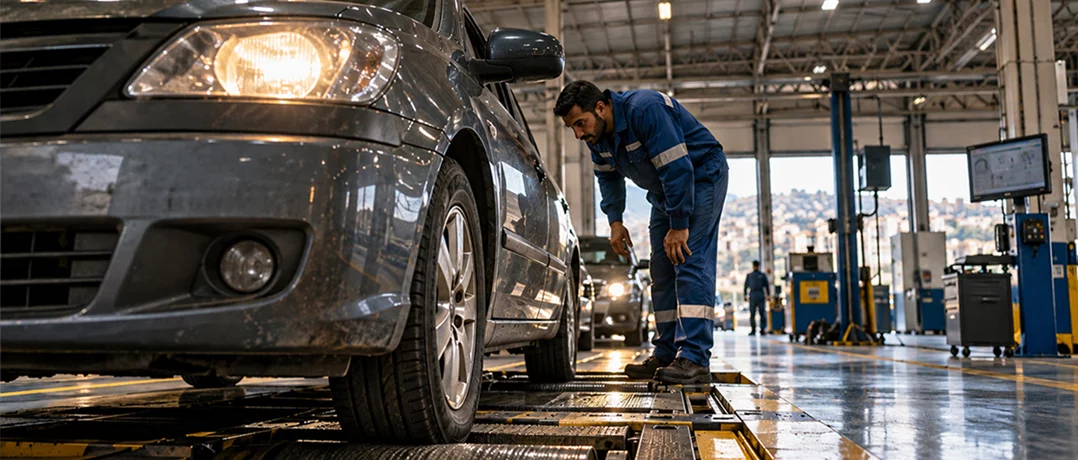
Cars without brake lights, worn-out tires, and black smoke rising from trucks and vehicles… Meanwhile, the millions of dollars that once flowed into the state treasury have become a thing of the past. The mechanical inspection system remains suspended. Will it return, as before, as a mandatory requirement for paying the annual vehicle registration fees?
Since mechanical inspections were suspended in Lebanon on 20 May 2022, vehicle testing has no longer been required for paying annual vehicle registration fees. Meanwhile, thousands of cars, trucks, and motorcycles continue to travel on the roads without meeting even the minimum public safety requirements.
Four years have passed, during which the number of vehicles has increased, while oversight and the most basic elements of public safety have disappeared. Vehicles emitting excessive smoke, lacking proper lights, or operating without functional brakes have become a daily sight on the roads, contributing to pollution and adding another factor behind traffic accidents, alongside deteriorating road conditions, including potholes and complete darkness due to poor lighting.
Between the threat to citizens’ safety and the state treasury’s loss of millions of dollars in revenues, the issue of restoring mechanical inspections has resurfaced: Will the system return this time through a more transparent and effective mechanism, or will chaos on the roads remain the norm?
In this context, informed sources told Nidaa Al Watan that Minister of Interior and Municipalities Ahmad Al-Hajjar has requested that the Traffic, Trucks and Vehicles Management Authority prepare the terms of reference for launching a tender, and that work is currently underway within the authority to complete them.
Addressing previous flaws
There is no doubt that the principle of mechanical inspection serves an important purpose by encouraging citizens to maintain their cars and trucks operating on the roads and ensuring minimum public safety standards, including functioning lights, acceptable emissions levels, working windshield wipers, and proper tires. However, the implementation process was deeply affected by irregularities, as fraud often occurred outside inspection centers. Some mechanics would reportedly target citizens by temporarily replacing defective vehicle parts—for example, changing an unusable tire with a functioning one before inspection and then reinstalling the old tire afterward.
Over the past four years, road conditions have continued to deteriorate, particularly regarding emissions from cars and trucks, as well as the presence of vehicles operating without brake lights or proper headlights. This has placed citizens’ health and safety at greater risk, further worsening an already problematic situation. In addition, state revenues have declined, as the government previously received 35% of the revenues generated by the company operating the mechanical inspection centers.
In this context, Simon Georges, former head of inspection lines at the mechanical inspection centers and a founding member of the Workers and Employees Union Committee of the mechanical inspection sector—which remains a committee—told Nidaa Al Watan that inspection centers previously tested one million vehicles annually, including passenger cars, trucks, vans, and motorcycles. These inspections generated revenues of US$28 million, from which the state collected between 30% and 35%, equivalent to approximately US$9–10 million annually, given that the inspection fee was US$22 for passenger cars and US$66 for trucks.
Today, the number of vehicles has increased, particularly cars operating on Lebanese roads, by approximately 300,000 vehicles over the past four years, excluding around 200,000 vehicles that were already violating the law by not undergoing inspections, without any effective oversight or mandatory insurance requirements.
He noted that the Workers and Employees Committee of the Mechanical Inspection Sector in Lebanon has requested a meeting with the President of the Republic to discuss solutions for restoring the mechanical inspection system.
Regarding the previous inspection process, Lebanon had four centers operated by the company “Val”. The new operating company was expected to open eight additional centers, but the tender was never completed to reduce pressure on the existing four centers, and no new company was appointed.
If mechanical inspections are reopened and taken over by a company, it would be required to employ 80% of the workers who previously operated the inspection centers, whose number stood at approximately 450 employees. This would create new employment opportunities, reduce citizens’ exposure to toxic emissions from vehicle exhaust, and generate revenues for the state, which is currently seeking every possible source of income through taxes imposed on gasoline and VAT in order to increase public sector salaries.
